
Proposal vs Quote: Key Differences and When to Use Each

Have you ever been unsure about when to send a proposal versus a quote?
A proposal is a formal document used for client onboarding, while a quote is typically used to outline payment for services.
Whether you’re a freelancer or running a digital agency, knowing which document to use can be crucial in landing the deal.
In this post, we’ll break down the key differences between proposals and quotes, helping you decide which one to use and when to move your business forward.
What Is a Proposal?
A proposal is a professional document that you send to potential clients to present a solution to their problem. It details your approach, the steps you’ll take, the timeline for completion, and the cost.
The primary aim of a proposal is to convince the client to move forward with your offer, but it’s not a legally binding contract.
A strong proposal is essential for many reasons.
It shows that you understand the client’s needs and goals better than anyone else.
By structuring your solution clearly and logically, you demonstrate how you’ll meet those needs.
Your expertise and past successes should shine through, helping to build trust with the client.
Additionally, focusing on the value and results you provide justifies your pricing and strengthens your offer.
Lastly, a well-crafted proposal makes it easy for the client to take the next step, whether it’s approving your proposal or scheduling a follow-up meeting.
What is a Quote?
A quote is a formal document that provides a detailed price estimate for a specific product or service based on the client’s needs. It outlines the costs, scope, and timeline, and is typically valid for a limited period, such as 30 days.
Unlike a proposal, which is more persuasive and comprehensive, a quote focuses solely on giving the client clear, accurate pricing information to help them make a quick decision.
If you can keep this in mind, you’ve got a solid understanding of what a quote is and how it works.
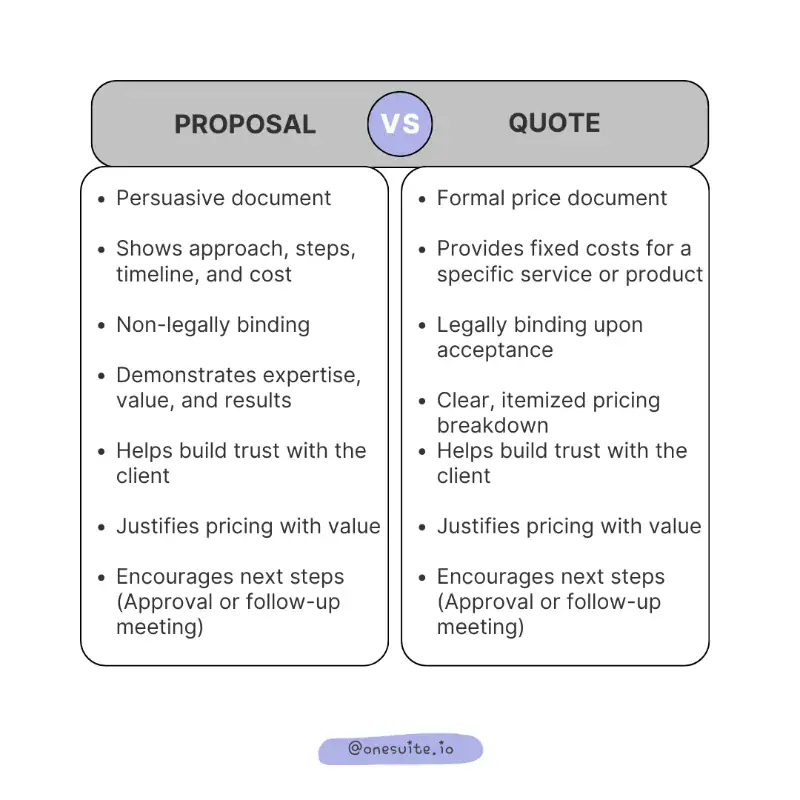
Key Differences Between a Proposal and a Quote : A Guide for Agency Owners
As an agency owner, deciding between providing a quote or a proposal for a new client is a critical decision that impacts how you present your services and structure your deals.
Here’s a clear breakdown of the key differences between the two, and when each is appropriate for your business.
1. Purpose: “Why and How?” vs “How Much?”
- Proposal: A proposal answers “Why this solution, why you, and how will it work?” It’s a comprehensive document that lays out the client’s problem, your strategy, expected results, and pricing. The goal is to demonstrate why your approach is the best solution for their needs and build trust in your ability to deliver.
- Quote: A quote, on the other hand, answers “How much will this cost?” It provides a straightforward, itemized breakdown of the costs for specific goods or services. The purpose of a quote is to give the client a fixed price to help them make a quick decision.
2. Who Controls the Scope?
- Proposal: With a proposal, you play a more active role in defining the scope. You assess the client’s needs, suggest what should be included or removed, and structure the project to ensure the best outcome. Essentially, you’re guiding the project’s direction to deliver optimal results.
- Quote: In contrast, with a quote, the client typically defines the scope first (e.g., “We need 10 pages, logo design, and hosting”). You’re then simply reacting to what they’ve already decided, providing a price for the work they have specified.
3. Depth of Content
- Proposal: A proposal is a detailed document, often 5–15 pages long. It includes a clear problem statement, goals, a detailed solution approach, pricing, timelines, and proof of your expertise (case studies, testimonials, portfolio). It’s designed to build trust and persuade the client to choose your solution.
- Quote: A quote is typically short, often just 1 page. It provides an itemized price list with quantities, unit costs, and totals. It is purely focused on the price and doesn’t go into detail about how you’ll solve the problem or why your solution is the best.
4. Role in the Sales Process
- Proposal: Proposals are best for complex or strategic projects where the client needs to understand the bigger picture and your approach to solving their problem. For example, a proposal works well for a full brand overhaul, a comprehensive digital marketing plan, or a long-term retainer.
- Quote: Quotes are better for simple, clearly defined projects where the client knows exactly what they want. For example, a one-time service like logo design, a minor website update, or a fixed-price package.
5. Legal/Commitment Level
- Proposal: A proposal is typically not a legally binding contract. It is a tool to help the client decide whether to move forward with your offer. Once the proposal is accepted, it can be converted into a contract, but by itself, it’s usually not legally enforceable.
- Quote: A quote, once accepted, becomes a binding agreement for the stated price and scope, in many cases. It serves as a simple contract but often has fewer legal details compared to a formal contract.
6. How They Affect Positioning and Trust
- Proposal: A proposal positions you as a partner or specialist. It’s a comprehensive presentation that shows you understand the client’s needs, and positions you as a trusted expert. This helps you justify higher prices because you demonstrate the value and impact you’ll deliver.
- Quote: A quote positions you as a vendor, focused on providing a price. It works best when the client already trusts you or when the job is small and doesn’t require much strategy or planning.
7. Simple Way to Remember
- Proposal = “Here is the plan and value, and here is the price at the end.”
- Quote = “Here is the price for what you asked for.”
When to Use a Proposal and Quote?
Proposals should be used for strategic, complex projects where you need to build trust, present a solution, and justify your pricing. They work well for clients who need guidance and reassurance about the project’s direction and benefits.
Quotes, on the other hand, should be used for simple projects where the scope is already clear, and the client just needs to know the price.
It’s ideal for smaller, one-time services or when the client has already decided what they want.
Whether you’re creating a quote or drafting a proposal, OneSuite provides a document hub to create, send, and e-sign both—streamlining the process for you and your clients.
Best Practices for Winning with Quotes and Proposals Using OneSuite
#Winning with Quotes
As a digital agency owner, sending quotes quickly—within 24 hours—is essential.
With OneSuite, you can easily create and send itemized quotes that clearly outline the costs and scope. Restate the scope briefly, and include a validity period (e.g., 30 days) to encourage quick decisions.
Personalize each quote with client-specific details, and end with a clear call-to-action like “Click to approve” for easy client interaction.
#Winning with Proposals
Start your proposal by addressing the client’s challenges and goals. Use the 3Ps structure:
Problem → Proposed Solution → Pricing.
With OneSuite, you can quickly create professional proposals that highlight your digital solutions, such as website redesigns or digital marketing strategies.
Keep it concise with headings and visuals, and use OneSuite’s e-signing feature to get approvals fast. End with a clear call-to-action, like “Schedule a call” or “Let’s get started.”
FAQs
What Should I Include in a Proposal?
A well-crafted proposal should clearly outline the project, its scope, and expectations. Here are the key sections to include:
– Project Overview
– Problem Statement
– Solution Strategy
– Deliverables
– Timeline
– Budget
– Team and Roles
– Risk Assessment
What Should I Include in a Quote?
A professional quote should include key details to ensure clarity and avoid misunderstandings. Make sure to include:
– Business name/logo and contact details
– Unique quote number
– Issue and expiry date
– Itemized description of goods/services
– Total cost, including tax (VAT)
– Payment terms
– Signature line
Are E-Signatures Legally Binding for Quotes and Proposals?
Yes, e-signatures are legally binding in most countries, providing a secure and efficient way to finalize quotes and proposals.
Find a Better Way to Grow
OneSuite streamlines projects, clients, and payments in one place, making growth hassle-free.