

Free SEO Retainer Agreement Template (DOCX Download)

June 17, 2026
When onboarding a new client, clarity is the foundation of a successful SEO partnership. Before any work begins, it is essential to establish a clear understanding of the services, expectations, deliverables, timelines, and responsibilities between both parties.
This SEO Retainer Agreement Template is designed to ensure a smooth onboarding process by defining exactly what will be delivered, how performance will be measured, and what each party is responsible for throughout the engagement.
By setting these terms upfront, both the Service Provider and the Client can avoid confusion, eliminate scope issues, and build a transparent, long-term SEO growth partnership focused on measurable results.
Download Your Free SEO Retainer Agreement Template
What Is an SEO Retainer Agreement?
An SEO retainer agreement is a written agreement between an SEO provider and a client for ongoing SEO work, usually on a monthly basis.
Instead of hiring someone for a one-time task, the client pays a regular fee to keep SEO work moving every month. This can include keyword research, technical fixes, on-page optimization, content planning, link building, local SEO, reporting, and strategy calls.
The agreement makes the working relationship clear from the beginning. It explains what services are included, how much the client will pay, when reports will be shared, what the client needs to provide, and how extra work will be handled.
For agencies and freelancers, it helps protect time, payment, and scope. For clients, it gives a clear view of what they are paying for each month and what they can expect from the SEO service.
Why SEO Retainer Agreements Matter for Agencies and Freelancers
SEO retainers work because SEO is ongoing. A signed agreement keeps the monthly work clear, protects the agency from unpaid extras, and helps the client understand exactly what they are paying for.
1. Predictable Monthly Revenue
An SEO monthly retainer turns one-time projects into recurring income. Instead of chasing new clients every month, agencies can plan revenue, workload, tools, and team capacity more confidently.
2. Higher Client Retention
Retainer clients usually stay longer because the relationship is ongoing. With clear deliverables, monthly reports, and regular communication, the client can see progress and understand the value of the work.
3. Less Scope Creep
SEO clients often ask for “quick” extras like new landing pages, extra keyword research, audits, or content updates. A retainer agreement clearly separates included services from paid extra work.
4. Clear Monthly Deliverables
The agreement should list exactly what is included each month, such as:
- 4 content briefs
- 10 on-page SEO updates
- 1 technical SEO review
- 1 monthly report
- 1 strategy call
This makes the retainer easy to manage and reduces confusion.
5. Better Expectation Management
SEO takes time. A strong agreement explains that rankings, traffic, and leads cannot be guaranteed because results depend on competition, search engine updates, website quality, and client cooperation.
6. Stronger Client Trust
Clients like predictable costs. A fixed monthly retainer helps them know what they are spending, what they will receive, and when they will get reports or updates.
7. Clear Accountability
A retainer agreement defines how performance will be tracked, such as keyword rankings, organic traffic, conversions, leads, technical fixes, or content performance. This helps agencies prove value every month.
8. Better Fit for Modern SEO
SEO now includes more than traditional rankings. Many retainers also cover content updates, technical health, local SEO, AEO, and GEO for AI search visibility. A monthly agreement gives agencies room to adjust strategy as search changes.
9. Protection Before Work Starts
The agency gets payment protection, scope control, and clear boundaries. The client gets a written record of services, timelines, reporting, access needs, and cancellation terms.
In short, an SEO retainer agreement creates a more stable, professional, and scalable relationship for both sides.
What Should a Retainer Agreement for SEO Services Include?
A good SEO retainer agreement should make one thing clear: what the client is paying for every month and what the SEO provider is responsible for delivering. Keep it simple, specific, and easy to review before work starts.
Agency and Client Details
Start with the basic legal details. Add the agency name, client name, business address, email, phone number, main contact person, and agreement start date.
Use the official business name, not just the brand name. It makes the agreement cleaner and more professional.
SEO Services and Scope
Write exactly what SEO services are included in the retainer.
This can include technical SEO, on-page SEO, keyword research, content planning, local SEO, link building, monthly reporting, or consulting calls.
Also mention what is not included. For example, paid ads, website development, copywriting, PR, graphic design, or extra landing pages should be listed as separate work if they are not part of the retainer.
Monthly Deliverables
Turn “SEO work” into clear monthly tasks.
Example:
1 SEO report
2 review calls
5 on-page updates
4 content briefs
1 technical SEO check
Keyword tracking
This helps the client understand the value they are getting and helps you avoid unlimited requests.
Retainer Fee and Payment
Add the monthly fee, payment due date, billing cycle, payment method, taxes, late fees, and refund terms.
A useful line to include:
SEO work may be paused if payment is not received by the due date.
This keeps payment expectations clear from day one.
Contract Term and Renewal
Mention how long the retainer will run.
Common options are month-to-month, 3 months, 6 months, or 12 months.
Also add cancellation notice, auto-renewal terms, and when pricing may be reviewed.
Client Responsibilities
SEO depends on client support too. Add what the client must provide, such as website access, Google Analytics, Search Console, brand details, content approvals, product information, and timely feedback.
Also mention that client delays may affect timelines and deliverables.
Tools and Access
List the tools or accounts needed to do the work.
This may include CMS access, Google Analytics, Google Search Console, Google Business Profile, hosting access, SEO tools, or developer access.
Also clarify who owns the accounts and who pays for paid tools.
Reporting and Communication
Set a simple communication rhythm.
Example:
Monthly SEO report
Monthly strategy call
Weekly email update
Shared dashboard access
This prevents random daily check-ins and keeps the retainer manageable.
Extra Work and Change Requests
Not every SEO request should be included in the monthly fee.
Extra landing pages, urgent audits, extra keyword research, content rewrites, technical fixes, or extra meetings should be quoted separately or billed hourly.
A simple line:
Any work outside the agreed monthly scope must be approved in writing before it begins.
SEO Performance Disclaimer
Do not promise rankings, traffic, leads, or revenue.
SEO depends on search engines, competition, website quality, content, technical issues, and client cooperation.
The agreement should promise the work, not guaranteed results.
Ownership of Work and Materials
Explain what the client owns after full payment.
The client may own final reports, keyword maps, content briefs, optimized copy, and approved strategy documents.
The agency should keep ownership of internal templates, systems, checklists, research methods, drafts, and private processes.
Template line:
After full payment, the Client owns the final approved SEO materials created for the Client. The Provider keeps ownership of internal tools, templates, methods, drafts, and working materials not delivered as final work.
Suspension and Termination
Add when work can be paused or the agreement can end.
Common reasons include late payment, missing access, delayed approvals, breach of contract, misuse of access, or written cancellation notice.
Also explain what happens after termination: final invoices, unpaid fees, access removal, account handover, and unfinished work.
Template line:
Either Party may end this Agreement with [X days] written notice. The Provider may pause work for late payment, missing access, delayed approvals, or breach of this Agreement.
Signature and Effective Date
End with a simple signature section.
Include name, company, title, signature, date, and effective date.
For online work, you can also allow e-signature or online approval through OneSuite.
Template line:
By signing this Agreement, both Parties confirm that they have read, understood, and agreed to the terms. This Agreement becomes effective on [Effective Date]. Electronic signatures or online approval will be treated as valid acceptance.
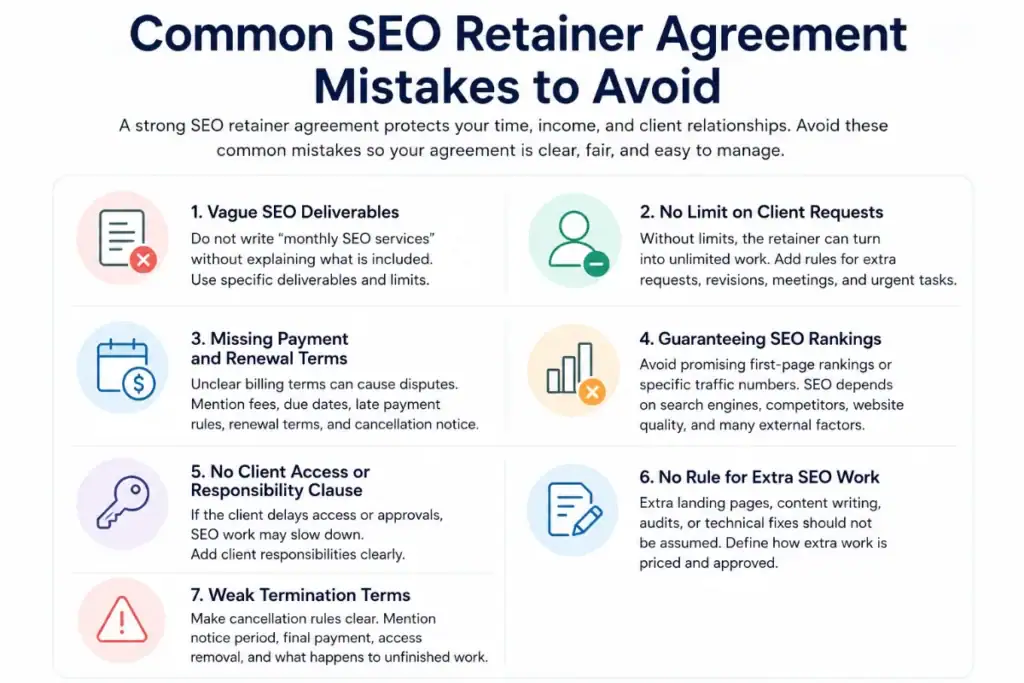
Common SEO Retainer Agreement Mistakes to Avoid
Even a good SEO retainer can create problems if the details are too loose. Before sending your agreement, check these common mistakes so the client understands the scope, payment rules, access needs, extra work policy, and cancellation terms clearly.
How to Create and Sign an SEO Retainer Agreement with OneSuite
OneSuite makes it easy to prepare, send, sign, and store your SEO retainer agreement in one place. Once your template is ready, you can upload it, add signature fields, invite your client, and keep the signed copy safely stored online.
1. Log In and Open Documents
Sign in to your OneSuite account and go to the Documents section from your dashboard. This is where you can upload and manage your agreement files.
2. Upload Your SEO Retainer Agreement
Upload your completed SEO retainer agreement as a PDF. Before uploading, check the client name, service scope, pricing, payment terms, and signature section.
3. Add Signature and Date Fields
Place the required fields on the document, such as signature, date, initials, checkbox, or text fields. Assign each field to the correct signer so the client knows exactly where to complete the agreement.
4. Add Your Client as a Signer
Enter your client’s name and email address, or select them from your saved contacts. You can also customize the signing email with a short message before sending.
5. Send, Sign, and Store the Agreement
Send the agreement to your client for online signature. The client receives a secure signing link, reviews the document, and signs it online. After both parties sign, the agreement is locked, stored in OneSuite, and ready to download with signature proof.

Related Topics to Grow Your SEO Agency Faster:
- How to Write an SEO Proposal
- How to Create a Legally Strong SEO Contract Template
- How to Write an SEO Quotation Template
- Best Client Management Software for Scaling SEO Agencies
FAQs
How does an SEO monthly retainer work?
The client pays a fixed monthly fee for agreed SEO services. The agency provides ongoing work, reporting, and strategy based on the scope in the agreement.
How much should an SEO retainer cost?
The cost depends on the scope, website size, competition, deliverables, tools, and agency experience. Some retainers are fixed monthly packages, while others are hourly or custom-priced.
What are SEO retainer services?
SEO retainer services are ongoing monthly SEO tasks such as keyword research, technical SEO, on-page optimization, content planning, link building, local SEO, and reporting.
Should an SEO retainer agreement guarantee rankings?
No. SEO agreements should not guarantee specific rankings, traffic, or revenue. Instead, they should define the work, process, reporting, and responsibilities.
Can an SEO retainer agreement be signed online?
Yes. You can use OneSuite to send the agreement, collect e-signatures, and store the signed copy securely
Start exploring OneSuite today
No credit card is required